EduResilience Summit 2025: CARE in Action


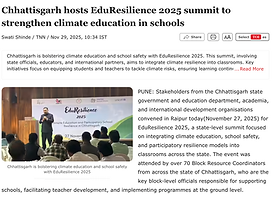
EduResilience 2025 brought together Educators and school leaders; Government officials, Raipur Science Centre, Representatives from UNICEF, Language and Learning Foundation (LLF), SAMARTH, IISER Pune CARE Project team, Science educators and community organisations.
More than 70 Block Resource Coordinators (BRCs), each supporting hundreds of schools across Chhattisgarh, participated in the summit.
Five Focus Areas of the Summit
1. Knowledge Co-Creation
Developing climate education approaches together with schools, scientists, government departments, and civil society organizations.


5. Partnership Framework
Strengthening long-term collaboration between IISER Pune, Samagra Shiksha Raipur, Raipur Science Centre, UNICEF, Language and Learning Foundation, Samarth.

2. Participatory Monitoring
Encouraging students, teachers, and communities to observe and track local environmental changes such as temperature, air quality, and health impacts.

4. Policy Integration
Promoting the inclusion of climate resilience in school health, safety, and infrastructure programs.

3. Capacity Building
Training teachers and education staff in environmental monitoring and interpretation of climate-related data.
Highlights of the Summit
Features
-
The summit featured insights from Dr. M. Sudhish of Samagra Shiksha, Dr. Shalini Sharma of IISER Pune, and Vishal Vasvani from UNICEF.
-
Participants also engaged with hands-on demonstrations led by Ashok Rupner and Ankish Tripude from the IISER Pune Science Activity Centre, along with a session by Seema Sirohi from the Centre for Language and Learning Foundation.
School Safety and Preparedness
-
The summit also highlighted the Chief Minister’s School Safety Programme (CMSSP), supported by UNICEF, as an important initiative for strengthening school preparedness and resilience.
-
‘This is an important and promising step toward strengthening climate-resilient education and improving preparedness in schools. Ensuring that children can continue learning safely, even in the face of climate-related disruptions, is central to UNICEF’s work on climate action and school safety’, said Vishal Vasvani, Emergency Officer, UNICEF.
Reimagining Climate Education
-
Interactive sessions introduced classroom-ready activities linked with the National Education Policy (NEP), Youth Eco Club.
-
The sessions promoted experiential and hands-on learning approaches connecting science with real environmental contexts. Dr. M. Sudhish, Head State Pedagogy Cell, Samagra Shiksha Raipur emphasized in his keynote ‘‘No longer optional but foundational to safeguarding learning continuity and well being’’.
Climate Data and Schools
-
Dr. Shalini Sharma, Associate Professor, IISER Pune and Lead, CARE Project emphasised the importance of integrating climate-responsive thinking and experiential learning into the school ecosystem.
-
She shared insights on rising temperatures and heat stress, highlighting the importance of climate data in shaping future-ready schools and learning environments.


Outcomes: Building the Foundation for Climate-Resilient Education
The CARE Project and EduResilience 2025 have initiated an ongoing process of building partnerships, strengthening capacities, and creating pathways for climate action through education.
Key developments currently being strengthened include:
-
Building a shared understanding of climate-resilient education among schools, educators, and institutions
-
Initiating networks of teachers, Block Resource Coordinators (BRCs), and community stakeholders for collaborative environmental learning
-
Encouraging schools to adopt participatory approaches for observing local environmental and seasonal changes
-
Strengthening dialogue between scientific institutions, education departments, and development partners for long-term collaboration
-
Exploring integration of climate awareness into classroom practices, school safety, and student well-being initiatives
-
Supporting the development of activity-based and locally relevant learning models that connect science with everyday environmental realities
-
These efforts represent important early steps toward creating resilient school ecosystems that can respond to climate-related challenges while promoting sustainability and community participation.